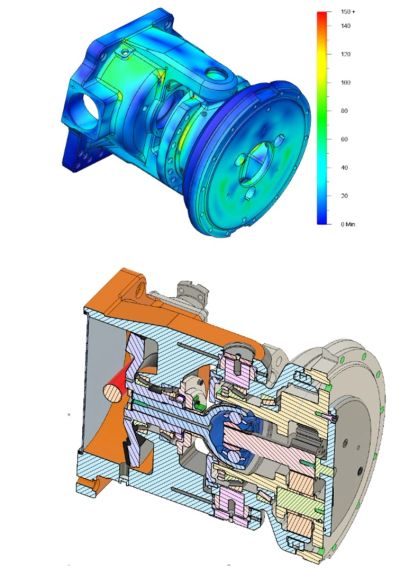
Shuttle Car Wheel Unit Structural Analysis
Project Details:
Total Value: $11 000
Year Completed: 2017
Duration: 2 months
Background:
This project involved a structural evaluation of a wheel hub assembly used in an underground shuttle car. The evaluation was conducted using Finite Element Analysis (FEA).
Description:
The analysis was initiated in response to unexpected failures of the wheel hub assembly during normal operation. The primary objective was to assess the structural integrity of the wheel hub assembly under typical maximum load conditions and to identify potential areas of concern in its design. Failures were predominantly observed in the driveline components of the assembly. Concerns were raised regarding the structural robustness of specific driveline components, which were subjected to regular operational loads. Additionally, the analysis investigated potential secondary loadings caused by distortion of the wheel hub housing assembly under load.
Shuttle Car Structural FEA
Project Details:
Total Value: $140 000
Year Completed: 2014
Duration: 5 months
Background:
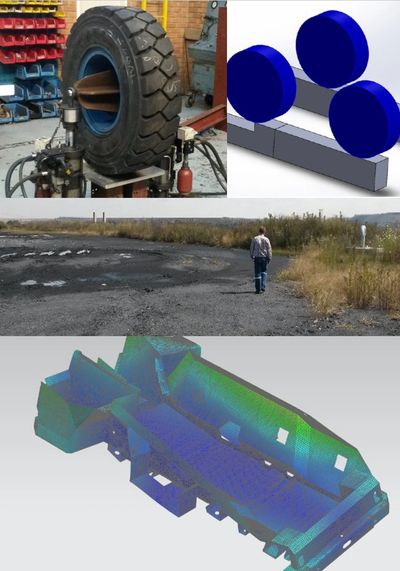
A mining company identified the need to develop a new Shuttle Car to meet future mining requirements at their facility. A new structural design and conceptual running gear layout were proposed, requiring Finite Element Analysis (FEA) and strain measurement data to validate the structural integrity of the design.
Description:
The manufacturing CAD models of the existing and proposed Shuttle Car structures were converted into FEA models with appropriate meshing. Preliminary load cases were developed to simulate potential operational scenarios. An existing Shuttle Car was instrumented with strain gauges, accelerometers, a speedometer, and displacement sensors. A test track was constructed, featuring specified obstacles and a random section to replicate underground conditions. Multiple tests were conducted by driving the Shuttle Car on the track, and the collected data was analyzed to validate both the load cases and the FEA model. Additionally, the wheels were tested separately to assess the running gear stiffness and its impact on the load cases. The verified loads were then applied to the new design to confirm the structural performance of the proposed Shuttle Car.

Shuttle Car Manipulator
Project Details:
Total Value: $288 000
Year Completed: 2013
Duration: 5 months
Background:
A mining workshop responsible for constructing Shuttle Cars for coal mines sought to enhance production line performance, product quality, and workplace safety. The development of a manipulator and jig system was justified to achieve these objectives.
Description:
The task at hand was to develop manipulator concepts through to commissioning, as well as designing and implementing final jigs for the manufacturing process. The jigs significantly improved productivity by enabling rapid alignment of subassemblies for welding, while also enhancing product quality through improved dimensional accuracy. The manipulator facilitated the rotation of the 16-ton weld assembly, providing safe and efficient access to all welding areas. Safety features, including electric safety curtains and platforms, were integrated to ensure a secure working environment for personnel handling the heavy assemblies.

Shuttle Car Development
Project Details:
Total Value: $550 000
Year Completed: 2010
Duration: 5 months
Background:
The existing fleet of Shuttle Cars used in a mining company’s collieries was considered outdated, with substandard performance. A systematic approach was essential to accurately identify and quantify areas for improvement based on available information. This required a detailed study to establish user requirements, pinpoint systems and components needing enhancement, and define precise technical performance measures.
Description:
A systems engineering approach was adopted, adhering to MIL-STD-499A for management principles and MIL-STD-490 for defining specifications of the primary items to be developed. The process began with the creation of a comprehensive user requirements document, followed by detailed functional and development specifications. Subsystem trade-off studies were conducted, accompanied by preliminary design and analysis. Maintenance concepts and production cost estimates were developed to inform life cycle cost projections. Additionally, risk management planning and operational principles were established to ensure the project’s success.